
Owners Let Go in an Order: First Findings From the Transferable Value Index
The Transferable Value Index is The McFarland Group's new quarterly measure of how closely held businesses hold up without their owners. The inaugural issue published today. It reports on the first 52 businesses to complete the assessment, and it opens with a letter from Byron McFarland, our founding principal, on the one thing owners reliably let go of last.
The findings run against the folklore. Owners delegate far more than they get credit for. Operations, client relationships, even bringing in new business have largely been handed off across this cohort. What lags behind everything else is a single question: who decides what the business does next.
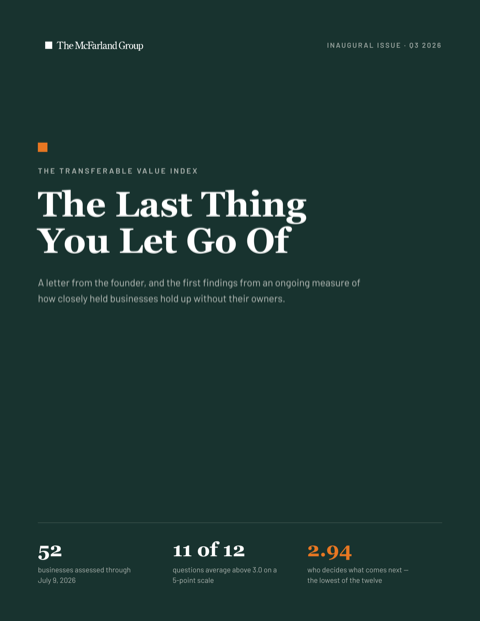
The Last Thing You Let Go Of
Four pages: all 52 businesses mapped by durability and independence, scores on every question we ask, and a letter from our founding principal that starts on a trout stream. No form, no email gate.
Download the PDFIf you would rather know where your own business lands before reading anyone else's numbers, the assessment takes about four minutes.
Why we built an index
Most owners find out how transferable their business is at the worst possible moment: in diligence, with a buyer across the table. The whole exit planning conversation tends to start after the clock is already running. We wanted a way to measure earlier, and to keep measuring.
The Index asks twelve questions about how a business would perform, and keep performing, without its owner. Six cover Business Durability: earnings, customer concentration, financial visibility, systems, workforce, resilience to disruption. Six cover Owner Independence: whether clients, sales, operations, money decisions, people decisions, and direction depend on one person. Each is scored 1 to 5, and every respondent gets their score and placement immediately.
The two dimensions together place a business in one of four quadrants. A Transferable Enterprise scores high on both: strong operations that run without the founder. An Owner-Dependent Success has a durable business that still routes through one person. An Emerging Enterprise has independence ahead of durability, common in younger companies. An Owner-Run Enterprise depends on its owner for both. Where a business lands tells an owner what kind of work is left, and the quarterly data tells all of us where owners as a group actually stand, as opposed to where the folklore puts them.
One caveat we will repeat in every issue: owners who take this assessment are owners already thinking about what comes next. This cohort is exit-curious by definition, and the findings should be read that way.
Most owners have already let go
There is a persistent story about founders of closely held businesses. They micromanage, they hold every relationship, and they cannot hand anything off. The first 52 businesses tell a different story.
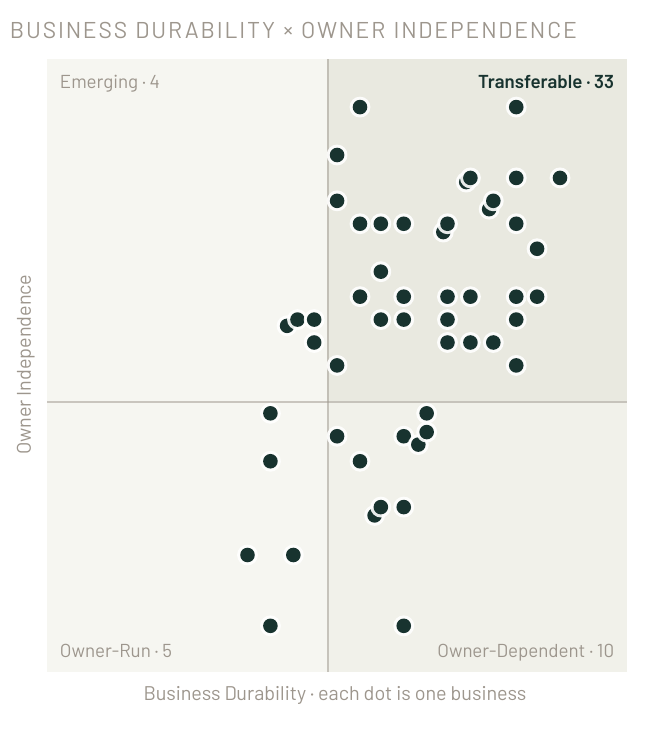
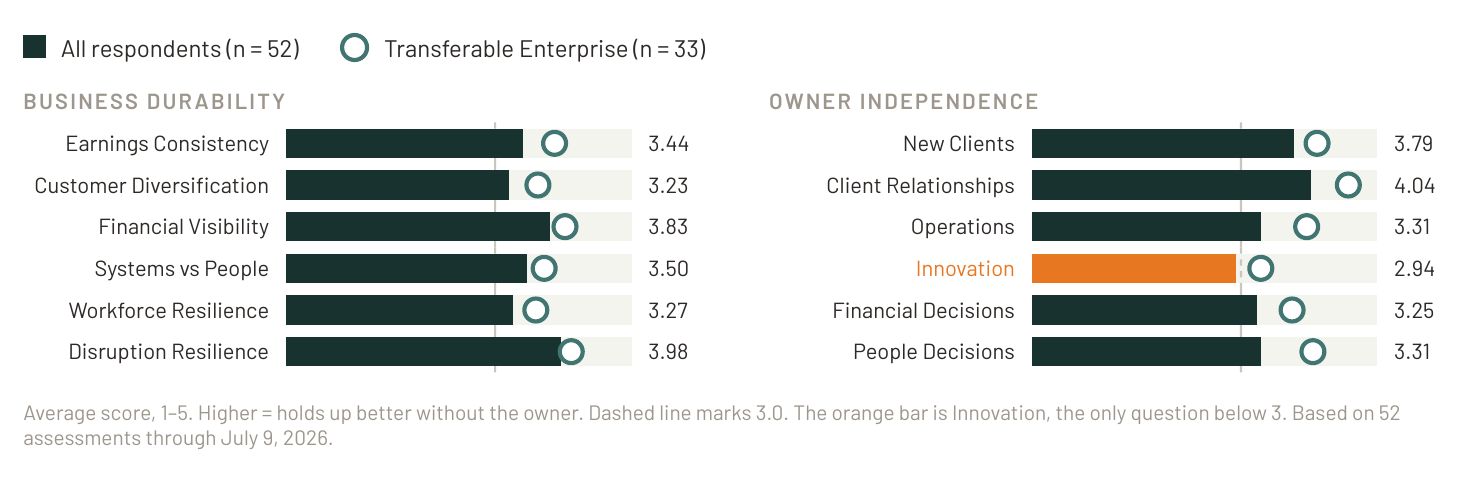
Thirty-three of the 52 score high on both dimensions: durable operations that also run without the owner. Across the full cohort, client relationships average 4.04 out of 5 and bringing in new clients averages 3.79, the third-highest score of the twelve questions. Handing off sales is supposed to be the hard part. It requires trusting the team to represent the company, close the deal, and protect relationships the owner spent decades building. Most of these owners have already crossed that threshold.
Look at where the dots cluster in Figure 1 and where they thin out. Weak businesses are scarce: just nine of 52 miss on durability. The crowded problem quadrant is the one to the lower right, where ten strong performers sit because the company still runs through its owner. If that describes your business, you are in the most common at-risk position in the data, and it is the position buyers, lenders, and successors price directly.
The one question below 3.0
Eleven of the twelve questions average above 3.0. The exception is who decides what the business does next. The question asks how much the leadership team participates in setting direction: new markets, new services, the next strategic bet. Running the current operation is a separate question, and owners score well on it. Shaping the future one is where the handoff stops. That question scores 2.94, and the gap to the next-lowest question, customer diversification at 3.23, is wide.
Anyone who has sat with an owner working through a succession plan will recognize this. An owner can read a delegation playbook for operations or sales. There is no playbook for giving someone else the pen on what the company becomes, because that authority never got written down anywhere. It has lived in one person since before the business had a name.
The pattern holds at the top
If the direction gap only showed up in struggling companies, you could dismiss it as a symptom of other problems. It shows up in the strongest ones. Within the Transferable Enterprise bracket, owners who have built real leadership teams, client relationships average 4.58 and new-client development 4.12. Deciding what comes next still trails everything else at 3.30.
Among the 30 highest-scoring businesses overall, 18 still have the owner alone deciding what to pursue next. The other twelve found ways to hand that authority to the team or genuinely share it. When you are weighing whether it is time to start planning, this is the gap worth measuring first: does the business know where it is going without you in the room?
A letter from the founder
The issue opens with a letter from Byron McFarland, who has spent thirty years advising owners of closely held businesses. It begins with a friend who had never held a fly rod, a good fish hooked too early, and the pull every fisherman knows: reach in, take over, land it for him. What that afternoon has to do with the 2.94 takes him two pages to explain, and we are not going to spoil it here, but this is the sentence the whole issue hangs on:
"What the data from our Transferable Value Index shows is something more specific, and more human: letting go happens in an order. And there is one thing that reliably comes last."
And this is the one that should make any owner stop scrolling:
"The last thing you let go of turns out to be the thing that most determines what the business is worth without you."
The letter is the heart of the issue and the best two pages we can offer on why these numbers look the way they do. Read it in the PDF.
What to do with this if you own a business
The conventional wisdom says preparing a business for transition means rebuilding it from the ground up: operations, financial reporting, leadership bench, key-person retention. The data says most owners have already done most of that work. What remains, for the typical owner in this cohort, is one discipline. Put the company's direction on paper so it stops living in one head. Widen the room where the next bets get argued. Let one directional decision run start to finish without stepping back in.
That matters commercially, because direction that lives in the owner's head cannot be audited, transferred, or financed. Standard diligence covers financials, operations, customer concentration, and management depth, and our data says most owners in this cohort would come through those checks reasonably well. What no diligence checklist captures cleanly is whether the company can decide where to go next without its founder in the room. A business that can answer that question is worth more to a buyer, and the deal closes with less friction.
Lenders read it the same way. A lender can verify a customer list and interview a management team, and a team that can also chart tomorrow's direction is worth more to a lender because the business will not stall the moment the founder steps back. Successors feel it most of all. An internal buyer who inherits a well-run operation without the authority to set direction is a caretaker, and the cost of leaving that unresolved lands on both sides of the table. When we work with owners on a sale to their management team, direction-setting authority is one of the first things we examine.
The owners in our data who score well on this did nothing dramatic. They gave the team real authority over one strategic decision, coached instead of taking it back when it wobbled, and expanded the boundary as conviction grew. If you have already let go of the first eleven things, the twelfth is closer than it looks.
About the Index
Twelve questions across two dimensions, Business Durability and Owner Independence, each scored 1 to 5. Dimensions are reported out of 30 and the combined index on a 100-point scale; a dimension scores High at 18 of 30. The inaugural issue covers 52 assessments submitted through July 9, 2026, with duplicate submissions counted once. The Index publishes quarterly and will report again as the cohort grows.
See where your business lands
The assessment takes about four minutes. You get your score on both dimensions and your quadrant placement immediately, along with a short personal report on where your business holds up and where it leans on you. No gate, no sales call. The businesses in Figure 1 are anonymous, and yours would be too, but the more owners who take it, the sharper each quarter's picture gets.
Take the assessment at transferablevalueindex.com
And for the full picture, the quadrant map, every score with the top-bracket overlay, the letter, download the inaugural issue, The Last Thing You Let Go Of (PDF). It is the version worth forwarding to a partner, an advisor, or the management team that might run the place someday.
Related posts

An ESOP Is a Way to Sell Your Business
A plain-English guide to using an ESOP as one option for selling a closely held business, including owner payout, tax considerations, fit, risks, and comparisons.
September 22, 2026 · 8 min read

Business Broker vs M&A Advisor vs Investment Bank
A practical comparison of business brokers, M&A advisors, and boutique investment banks so owners can choose the right rung before choosing the person.
September 22, 2026 · 8 min read